


NSW Government introduction of annual permits for non-desexed cats and dangerous / restricted dogs

July 12, 2020
NSW Government introduction of annual permits for non-desexed cats and dangerous / restricted dogs

The NSW Government is introducing annual permits for non-desexed cats and restricted and dangerous dogs as part of its commitment to promoting responsible pet ownership and improving animal welfare standards.

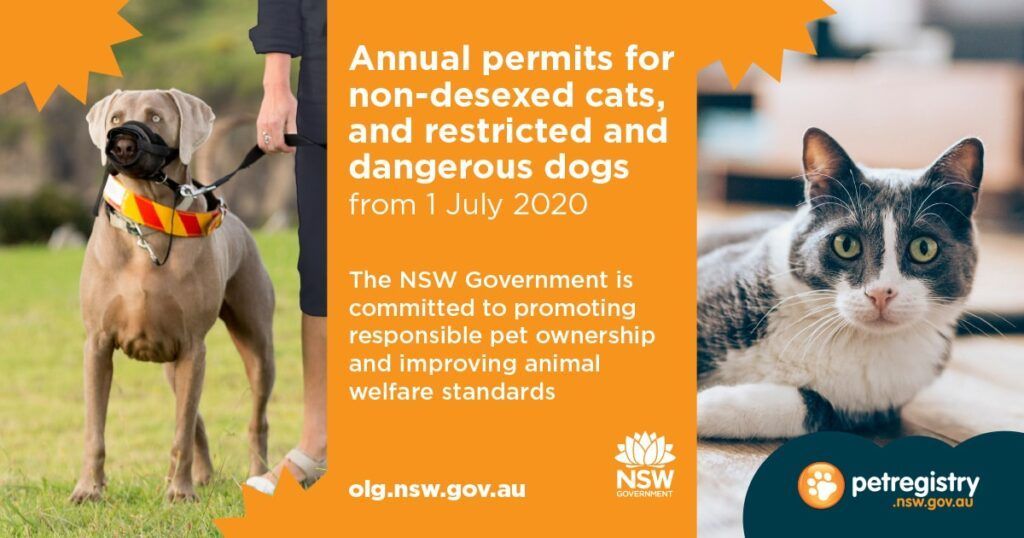
Advertisement about annual permits for pets. Dog on leash, cat, text on a blue background.

The NSW Government is introducing annual permits for non-desexed cats and restricted and dangerous dogs as part of its commitment to promoting responsible pet ownership and improving animal welfare standards.


From 1 July 2020 owners of cats not desexed by four months of age will be required to pay an $80 annual permit in addition to their one-off lifetime pet registration fee.

This will create a stronger incentive to desex cats, which in turn will improve their health and wellbeing, including reducing the risk of some cancers.

Improving desexing rates will also ease the burden on pounds and shelters, reduce euthanasia rates, and help to address concerns about feral, stray and roaming cats and their effect on wildlife.

Exemptions are in place for cats that are registered by 1 July 2020, those kept for breeding purposes by members of recognised breeding bodies, and cats which cannot be de-sexed for medical reasons.

Cats taking a selfie promoting de-sexing. Orange background with text and government logos.


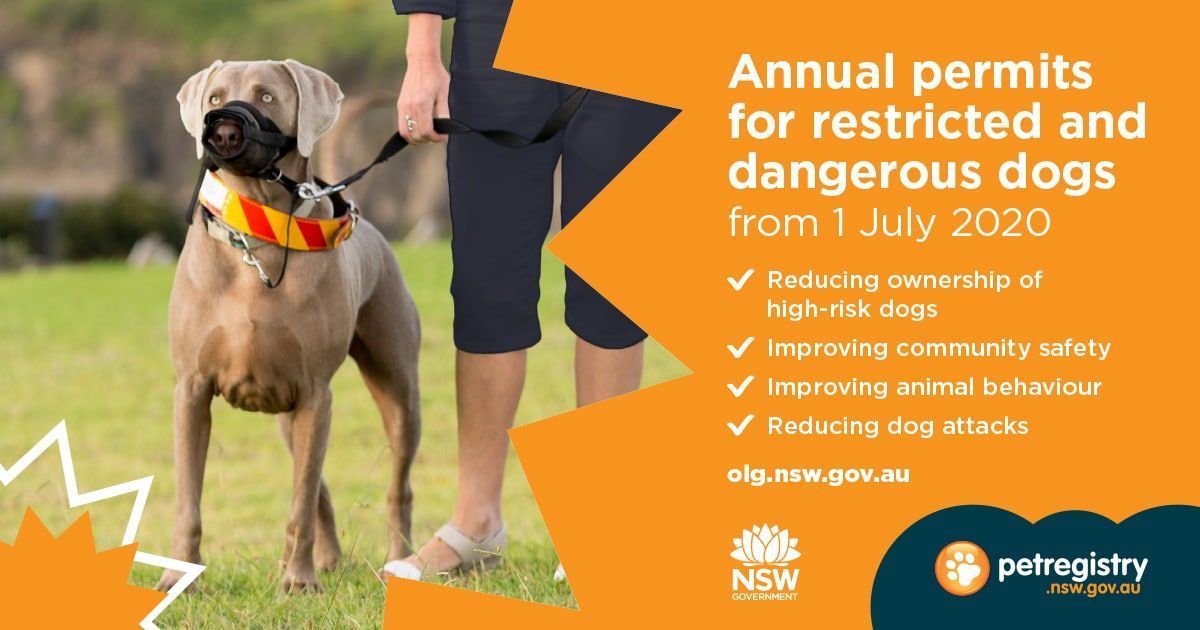
From 1 July 2020 owners of dogs of a restricted breed or formally declared to be dangerous will be required to pay a $195 annual permit in addition to their one-off lifetime pet registration fee, by NSW Government.

This will serve as a further disincentive to owning high-risk dogs and encourage owners to better manage the behaviour of their animal.

Restricted dog breeds are the pit bull terrier, American pit bull terrier, Japanese tosa, Argentinian fighting dog, Brazilian fighting dog, and canary mastiff. A dog can also be declared to be one of, or a cross-breed of, one of these restricted breeds.

Dogs of any breed can be formally declared dangerous by a council or court if the dog, without provocation, has attacked or killed a person or animal, repeatedly threatened to attack or repeatedly chased a person or animal, or is kept or used for hunting.

Dog on leash with orange and yellow collar; notice about annual permits for dangerous dogs from July 2020.


From 1 July 2020, pet owners will be able to pay for annual permits using the  NSW Pet Registry website  or through their local council.

Anyone registering a cat on the NSW Pet Registry will be informed that they must pay for an $80 annual permit if their animal is not desexed by four months of age.

Annual permit fees will go directly to the Companion Animals Fund which pays for companion animal management by local councils including pounds/shelters, ranger services, dog recreation areas, and education and awareness programs.  The fund is also used to operate the NSW Pet Registry and carry out responsible pet ownership initiatives.

Local councils will have primary responsibility for enforcing the new requirement consistent
with other companion animal management practices.

If you require any further information or assistance, please contact the NSW Pet Registry at  pets@olg.nsw.gov.au  and 1300 134 460.


#NSWPetRegistry #NSWGov #AnnualPermits #NonDesexedCats #RestrictedDangerousDogs #LocalCouncil

Recent Posts

A Cavoodle puppy sitting on the grass
February 5, 2026
Explore our complete Cavoodle dog breed guide and learn about their behaviour, health, grooming, training, and why they’re one of Australia’s favourite pets.
Dog lying on a bed wearing an elizabethan collar
February 5, 2026
Discover essential tips for helping your pet heal after animal surgery, including activity restrictions, pain management, wound care, follow-up vet visits and more.
A dog looking at a block of chocolate
February 5, 2026
This blog covers everything you need to know about chocolate poisoning in dogs, including potentially fatal amounts and what to do if your pet is at risk.
Show More